Auckland Radio and Awarua Radio were New Zealand’s two main radio direction-finding (DF) stations in the 1940s. Both stations offered two types of direction-finding services: Medium Frequency and High Frequency.
Medium Frequency Direction-Finding (MFDF)
The MFDF system used an antenna of the Marconi-Adcock type, erected at the high point of the present golf course, where the road curves around to the eastern side.
In the photo below, the four towers supporting this antenna are located within the white picket fence near the centre of the image.

The four MFDF aerial towers at Musick Memorial Radio Station can be seen within the white fence near the centre of this photo.

DF Mast ready for erection, circa 1942
There was also an extensive earth mat radiating out from the masts.
A multi-coaxial cable ran to the receiving station where the DF receiver was installed.
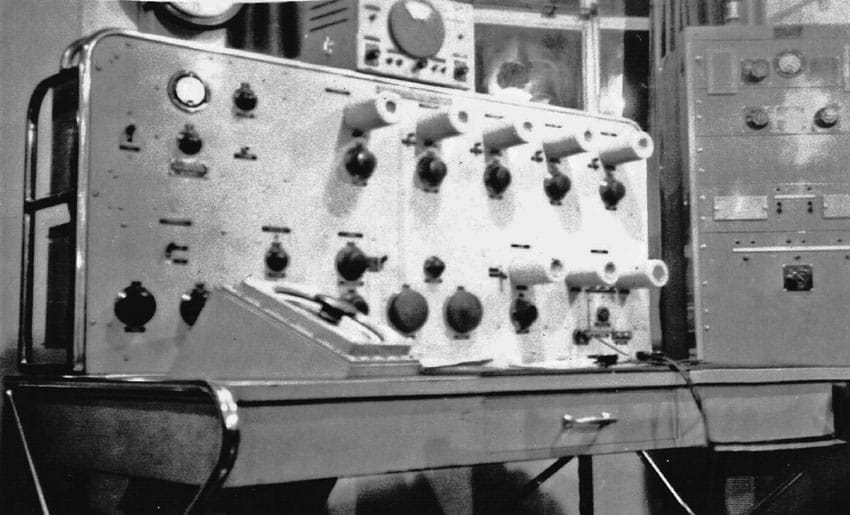
The MFDF receiver with its goniometer. To the right is the remote control for the 390 kHz transmitter. Photo: 1944, Morris Archives
The receiver was a four-stage TRF following the radiogoniometer, which was a rotating loop inside four quadrature coils (this is the small enclosure with the large dial seen at the lower left of the photo above). The loop was turned on a scale to indicate the direction of the received signal.
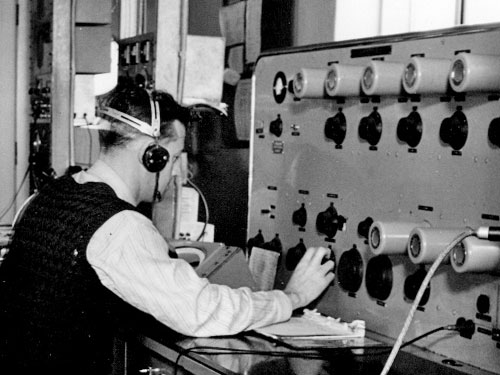
Jim Clark operating the MFDF receiver. Date unknown.
The sensitivity on the receiver and antenna system was such that it was possible to hear Australian broadcast stations at the bottom end of the band during daylight hours.
“Essentially a TRF receiver, the oscillator was first set to the frequency required and then each stage set for maximum response. Adjustments were fiddly but experienced operators could change frequency very quickly.”
– Doug Morris in Auckland Radio Alpha & Omega
The whole receiver was housed in an enormous console alongside the 500 kHz watch position. This console was last known to be at MOTAT, but is now lost.

The riggers responsible for erecting towers at Musick Memorial Radio Station

A rigger at work atop one of the 100' direction finding masts at Musick Point.
The seaward sector was carried out using a Navy or Marine Department vessel which carried field staff and circled the station from Cockle Bay at Howick to around Bean Rock, while a surveyor noted the direction of the boat with a theodolite and called it to stop when one of the calibration points was reached.
The boat then headed towards or away from the masts while sending the calibration signal on CW (Morse Code).
During one land sector calibration, a newer technician who had not been on this exercise before was in the field and was called on the 2045 kHz radiotelephone link to make the transmission on 500 kHz”. The transmitter was heard: “Z-L-E- silence”.
Then a plaintive voice was heard on 2045: “What’s ‘Y’ in morse?”
A 1949 article about Musick Point in 1949, in the New Zealand Free Lance, mentioned that the medium-frequency direction-finder was previously used to supply bearings to both aircraft and ships, but was now used only for shipping. High-frequency equipment was being used for aircraft direction-finding.
On the decommissioning of the MWDF, the masts were sold to a local amateur radio operator who erected one of them at his Pakuranga property and was to use the others to make bridges over a stream on his farm. The anchor blocks were sold as boat moorings.
During the lowering operation one of the masts got out of control and came down with such a crash that it flattened one of its square sides. It was, however, later straightened.
High Frequency Direction-Finding (HFDF)
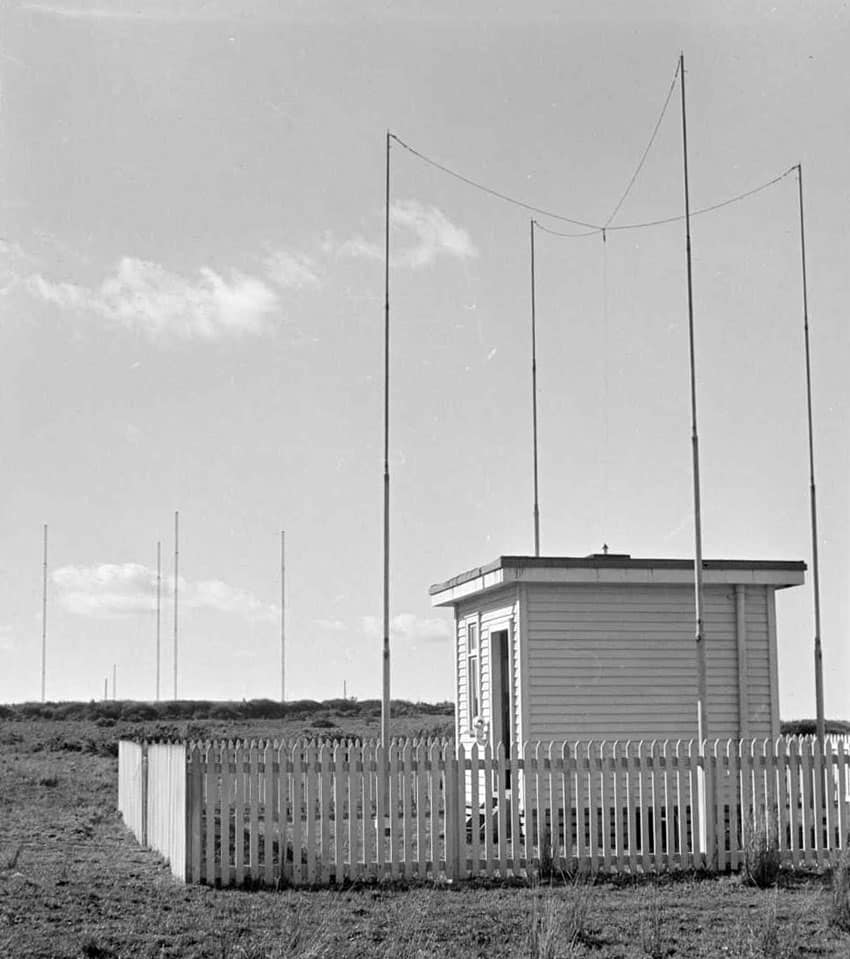
HFDF hut at Musick Point, 19 August 1946. The four towers for the MFDF can been seen in the distance. Photo: Whites Aviation
There was also a high frequency (short wave) DF hut, with four relatively short masts for its Adcock system aerial, located near the group of trees half-way along the road towards the MFDF site.
HFDF was used for aircraft positioning. (Civil Aviation also had a DF site, at Waiuku.)
The HFDF could not be operated from the receiving station, so the operator had to cycle up to the hut when a fix was requested. This DF had its own remote-controlled calibration oscillator.

Rex D Goodman operating the HF Direction Finder in the hut at Musick Point, 29 Aug 1946. Photo: Whites Aviation, Alexander Turnbull Library
The HFDF equipment was a Marconi Type DFG12 Mk1 Adcock system, comprising a superhet receiver (seen in front of the operator in the photo above) and to the left a unit containing two radiogoniometers. The DFG12 was developed in 1940 for military use and would have been considered old-fashioned by the time these photos were taken six years later. (During the war, Awarua Radio ZLB was upgraded to a Marconi DFG24 Mk2 receiver, but Musick Point apparently was not.)

Rex Goodman on HFDF duty in the hut at Musick Point, 29 Aug 1946. Photo: Whites Aviation, Alexander Turnbull Library
This article incorporates information from Eric Duffy ZL1ADE and Doug Morris ZL1QG

 Open the menu by clicking the “burger” icon at top right.
 Many menu items can be expanded to reveal subpages by clicking on the arrow. Click again to collapse the menu item.

