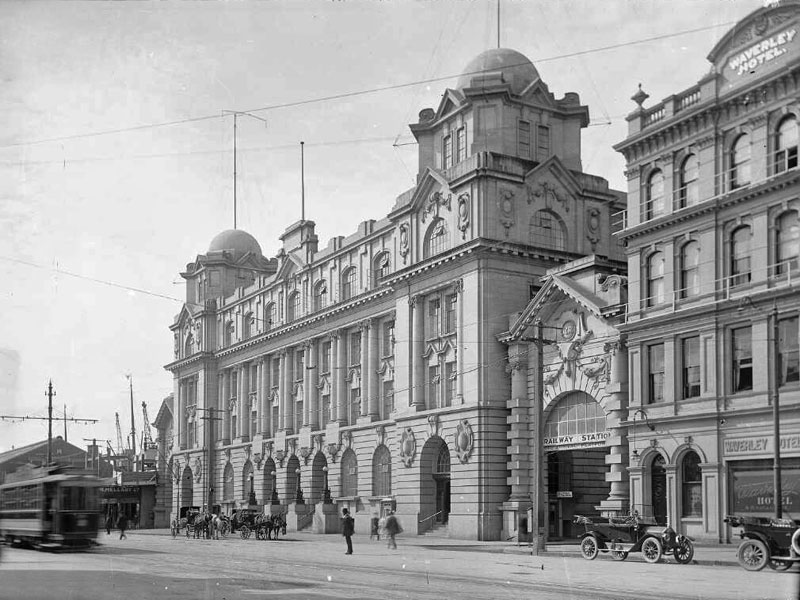
1912

Auckland’s new Chief Post Office opened in 1912. The building to the north (left of photo), housing Hellaby butchers, would soon be partially demolished. The large gate to the right of the CPO leads to the railway station and at the far right is the Waverley Hotel. Photo: Auckland Star, Alexander Turnbull Library
In this photo of Auckland’s new Chief Post Office, the building to the north has been mostly demolished. The aerial for Auckland Radio has been installed on the roof of the CPO, suspended between masts mounted on the building’s two domes. Photo c1912: WA Price, Alexander Turnbull Library

It is believed that this photo was taken in the radio cabin on the roof of the Auckland Chief Post Office, c1912. Photo possibly by WA Price, Alexander Turnbull Library
 On 24 October, radiotelegraph station Auckland Radio NZK began operation from a small hut on the roof of the new, and not yet opened, Chief Post Office.
The station used a Telefunken Type D spark-gap transmitter of 2.5kW.
The first manager was LW (Pat) Bourke (pictured).

“A wireless station for Auckland City: one of the masts in course of erection on the roof of the new Post Office.” Price Photo Co, Auckland Weekly News, 19 Sep 1912. Sir George Grey Special Collections, Auckland Libraries
The tubular steel masts of the station were erected on the two domes of the building, a distinctive feature of its ‘English Renaissance’ architecture. The domes themselves were 10.5m above roof level.1
After the new Auckland CPO was opened in November 1912, the PCB cable station was transferred to a location on its roof which it shared with Auckland Radio. Also in 1912, the Pacific cable itself was cut near the entrance to Doubtless Bay and redirected to Takapuna Beach. From here cable messages were relayed to the new CPO by overland wires. In 1912-1913 a new trans-Tasman cable was laid between Bondi (Sydney) and Muriwai on Auckland’s west coast, with messages from it reaching the city via an underground cable between Muriwai and Harkins Point. All these developments had made Auckland the country’s major overseas communications link on the eve of the First World War.2

This set of photos shows the original government wireless station for Auckland, located in a hut on the roof of the Chief Post Office in Queen Street. The aerial was suspended between masts erected on the building’s two domes, both of which are visible in the photo at top left.
1913

The original Auckland Radio station VLD was on the roof of the Chief Post Office
The station was open “during certain hours daily” and “excellent results” were obtained, although the range was “somewhat less than that of Radio-Wellington,” according to the Post & Telegraph Department’s annual report of 1913.
John L Davies replaced Pat Bourke as manager.
While the station’s spark-gap transmitter performed well, the effectiveness of the station was handicapped by poor receiving conditions, including local electrical noise.
Auckland Radio’s callsign was changed from NZK to VLD. (Later, on 1 Jan 1929 it changed to ZLD.)
Ralph S Wheeler replaced John L Davies as manager.
1914
The radio-station at Auckland is now used only for daylight work.
– Appendix to the Journals of the House of Representatives: Post & Telegraph Department, 1914
1915
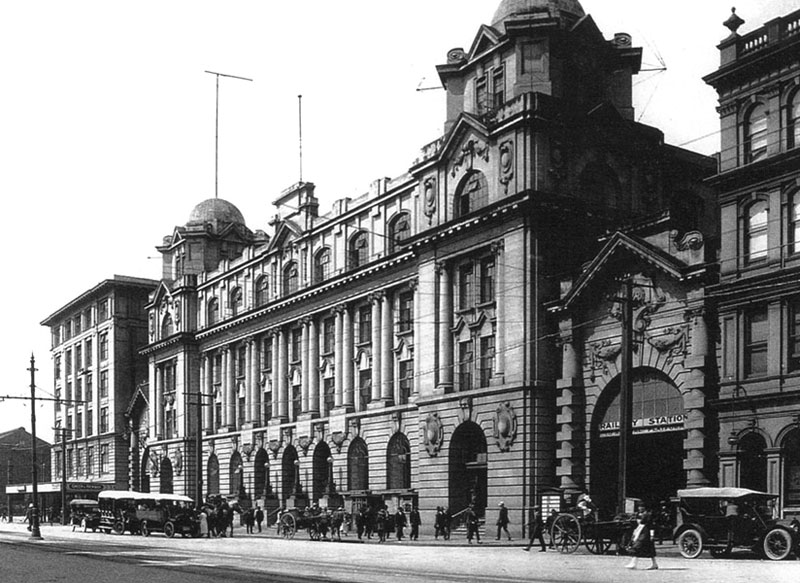
Auckland Chief Post Office c1915. To the north is the new 6-story Endean building.
On 8 May the Auckland station was closed – but not dismantled – as the high power station at Awanaui, near Kaitaia, was providing superior performance.
1917
Les H Steel became manager.
Improved methods of detecting signals by means of the ultraudion were introduced at Awarua, Wellington, and Auckland a few months ago, and apparatus for the other stations has been procured and will shortly be brought into use. The results obtained at Awarua, where the apparatus has been extensively experimented with, have been particularly gratifying. The signals of stations using damped and undamped waves invariably come in of readable strength from American, Asiatic and European stations. The use of this detecting-apparatus with a particular combination of the receiving-circuits has demonstrated that daylight signals from stations using the ordinary wave-lengths can be rendered plainly audible, which by the ordinary methods and the use of the crystal detector could not be heard.
– Appendix to the Journals of the House of Representatives: Post & Telegraph Department, 1917
Notes
1. Wilson, A.C. (1994). Wire and wireless: A history of telecommunications in New Zealand 1890-1987, (p 96), Palmerston North, New Zealand: Dunmore Press.
2. Wilson, A.C. (1994). Wire and wireless: A history of telecommunications in New Zealand 1890-1987, (p 104), Palmerston North, New Zealand: Dunmore Press.

 Open the menu by clicking the “burger” icon at top right.
 Many menu items can be expanded to reveal subpages by clicking on the arrow. Click again to collapse the menu item.

